






Cassiopeia
Version: 0.4.0
Category: Mia
(not yet rated)

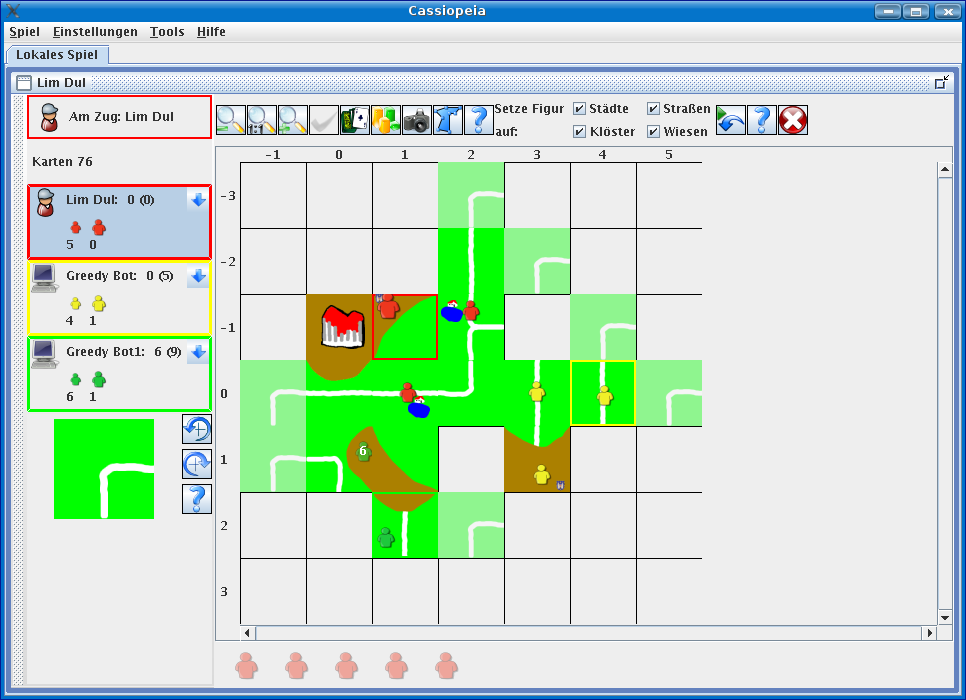 JAVA implementation of Carcassonne
This is a java implementation of the tile-placing board game Carcassonne.
You score points by laying tiles adjacent to each other and placing figures onto the tiles. If you close an area you get points proportional to the size of the area.
It is released under the GPL and features network play and computer players.
This game was listed as missing in action: it was no longer available when the site closed.
License: freeRequirements: JAVA 1.4 or better
| Sound: | Play in X: | Play in Console: | Multiplayer: | Network Play: | 3D Acceleration: | Source Available: |
|---|---|---|---|---|---|---|
| no | yes | no | yes | yes | no | yes |
Submitted by Lim_Dul on 2007-03-12.
Again... Why people keep writing and commenting code in their own language when they know English? It never occurred to you that if Linus had commented his code in Finnish no one would have helped him on? I am afraid English is a necessary tool in an open source model nowadays, exactly as gcc or make.
(and no, I am not a mother-tongue English speaker -- in case you didn't notice from my grammar mistakes :) )
While I agree that in a certain way open source wants to be english because it is the common language of computer programmer nerds, there ARE other sizable language pools to draw talent from. Japanese and German are obvious pools of programming talent where high levels of english skill is not common. As a result it is only to be expected that open source projects will come to exist within these pools of talent using their own language. Will such a choice tend to prevent non-german speakers from contributing? probably. But it will enable non-english speakers who speak german to contribute.
Given just how popular the designer style of board game is in Germany, it is an open question whether the english speaking set of interested programmers is larger than the german speaking set.
In any event, english will probably not remain the programmer lingua franca forever. Think of reading source such as this as practice for the future.
The handbook is only avaible in german because I was to lazy to translate it ;) That is something that will change.
There are some great German programmers out there, I work with quite a few, but pretty much every German who is the right age to know computers (under 40) knows really good English, I doubt writing in German really effects how many Germans you get hacking.
Anyway, the programmer lingua franca isn't likely to change in our lifetime, changes like that are slow and would take at least a lifetime since English is so ingrained as a compatibility language in most of the world (including official status in India which is set to be the world's most populous country in just a few years). Latin remained Europe's international language for over a millenium after Rome fell, surely if America, the UK, Australia etc. were to vanish, English could at least hold out for a century.
Pundits say the most credible next common language is Mandarin, which is dependent on China not having another Cultural Revolution/Boxer Rebellion/Taiping Civil War/Opium War/Qing Resoration or a repeat of any other even that has happened in China in the last 200 years. Any usage of a Chinese language would be dependent on it moving to an alphabetic script as Han characters are unlikely to take off outside China.
Anyway, I don't see the world moving to German as a common tongue, at one point it could have happened but decisions were made in Germany and Japan that shaped the late 20th century a different way.
That is of course not to say that this dude must write in English, if I were not an English speaker I'd be pretty pissed off if anyone told me that I must use a different language. All I'm saying is that if English is a powerful language today, it will be even more powerful tomorrow even if it is eventually doomed, it might indeed have a negative second derivative but its first derivative is still very positive. Language prevalence is not like CPU clockspeed and amount of RAM, cultural things just don't change that fast.