






Games for French pre-school
Version: 030205
Category: Kids
(not yet rated)

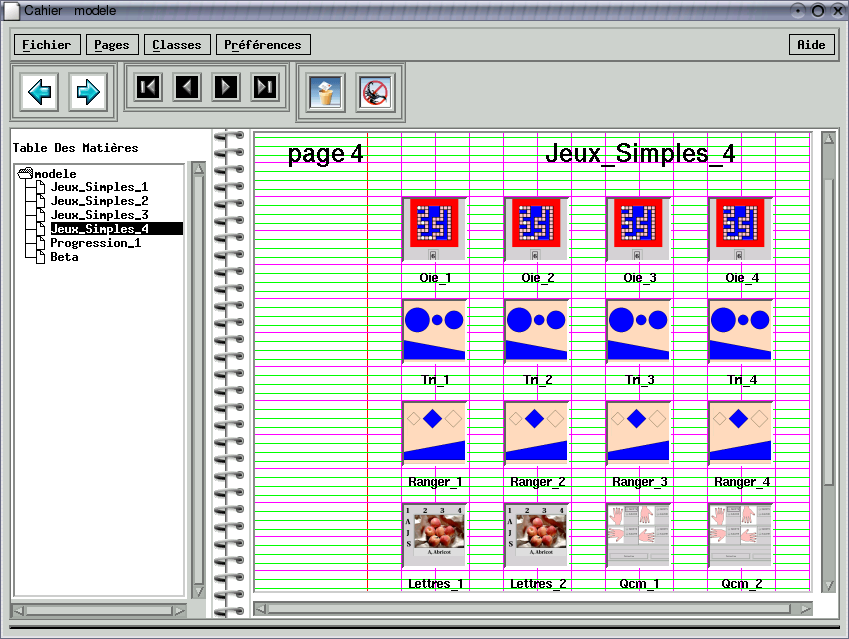 A collection of educational games in French
Games for French pre-school is a suite of educational games for French toddlers comprising seven packages including memory, letters falling, puzzle, labyrinth, letters & numbers, double entry arrays, domino, counting, enumeration, draw, sort, arrangement, ...
License: free
| Sound: | Play in X: | Play in Console: | Multiplayer: | Network Play: | 3D Acceleration: | Source Available: |
|---|---|---|---|---|---|---|
| no | yes | no | no | no | no | yes |
- Games for French pre-school home page
- Download Games for French pre-school
- More educational games on happypenguin.org
Submitted by nilfilter on 2003-03-19.
Greetings, people. I want to thank you all for providing this game. I've been studying the French language the past couple days and am happy this game is available. As much as it is *intended* for preschool(ers), I hope to try it ASAP I gain access to a desktop so I can test my 3-day knowledge of reading, writing, and speaking French. Can anyone give me any good points on becoming a master of using French? For those of you that don't know what I initially wrote, it may be mispelled, as it is my first sentance I constructed of my own volition and investment in French for the past few days...it says, "I love the woman"
How did I do? The information I primarly desire is that of understanding pronunciation as expressed by writing as well as howto better discern words spoken in French. I'm confused a little by all the different vowels too, yet can pronounce them in my short-term memmory after hearing them. Anyone willing to donate information to their fellow Linux developer? Thanks for the pointers, if any!
"J'aime" ("I love"), while grammatically correct, is not common usage in French, because when spoken it sounds too much like "jamais", which means "never". For the record, I learned this the hard way, while IN France. When a French person wants to say they like or love something, they use "J't'aime", "I love you", which, while not correct, avoids confusion.
I was trying to think of an English equivalent, but couldn't. Again, congratulations. :)
Is that anything like... J't'aime la ma main?
question: why do I always hear, sadly by slashdot rumor, that French-Canadians postfix "eh" or "guffah" at the end of every sentance? That isnt hillbilly francais, eh? And if anyone else is reading, or maybe the parent poster has time, what is the reason for "la" and "le" being used? I have not yet recognized a pattern for the interchange of "la" and "le" or what circumstance it is changed. "la" and "le" I understand is "The", eh?
GUFFAH! (I'm annoying already, eh?)
All French nouns have gender. That is, a noun is either masculine or feminine. The definite and indefinite articles ("the" and "a"/"an" in English) must agree with the noun they apply to -- that is they must match the gender of the noun. This So, "le" is the French for "the" for masculine nouns, "la" for feminine nouns. Also, "un" is "a" for masuline nouns, "une" for feminine nouns. You would say "la femme" (the woman) or "une femme" (a woman) but "le garcon" (the boy) or "un garcon" (a boy). If a noun starts with a vowel or an 'h', which is silent, you use "l'", so you would say "l'homme" (the man) or "l'ordinateur" (the computer).
To answer the first poster's question: the best way to learn French or any language is to use it as much as possible as often as possible. Go to France for a while, spend a lot of time with French people, and force yourself to never speak a word of English. You'll be amazed at how quickly you start to pick things up.