






Glarf
Version: 0.35
Category: Mia
Average of 1 Ratings: 

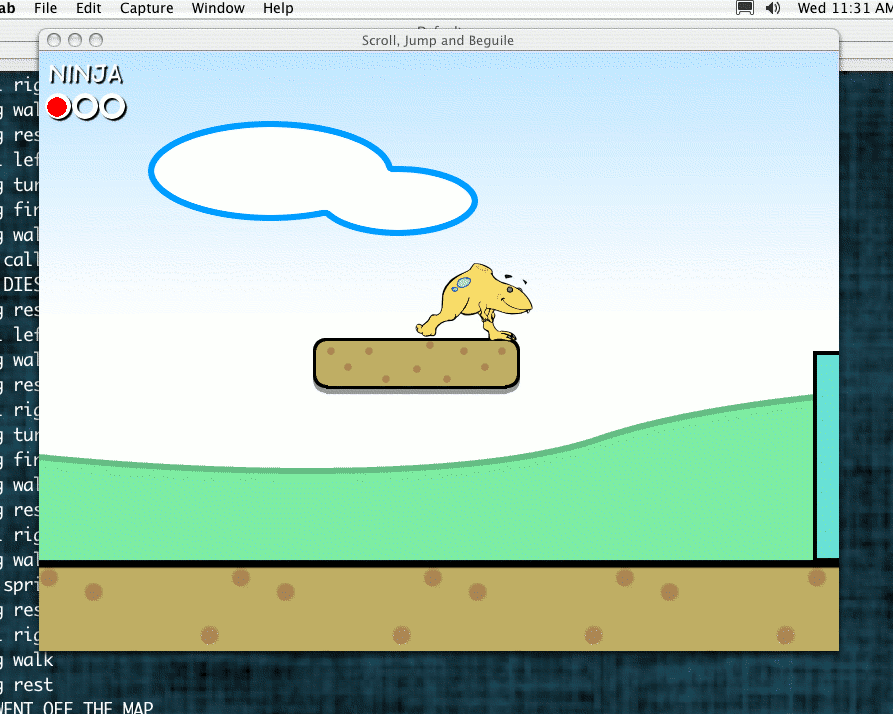 Weird creatures on platforms shooting weird things.
Glarf is the working title of a video game. It is a platformer like Mario or MegaMan or Contra, but that's not the Big Idea. The Big Idea is this: weapon crafting. Glarf can shoot things - fireballs, bouncy globs, liquids. When Glarf consumes a powerup, the things he shoots inherit some of that powerup's properties.
All character animation is classically animated by hand.
This game was listed as missing in action: it was no longer available when the site closed.
License: freeRequirements: Coded in pygame, you need to get pygame if you want to play in the source code. The binaries should not require any dependency downloads.
| Sound: | Play in X: | Play in Console: | Multiplayer: | Network Play: | 3D Acceleration: | Source Available: |
|---|---|---|---|---|---|---|
| yes | yes | no | no | no | no | yes |
Submitted by sjbrown_ on 2005-06-24.
Shots being fired out of "glarf" appear out of nowhere, need animation of it shooting out.
When enemies get trapped by shots from "glarf" things start flickering.
Looks to be a very promising game. Setup an RSS feed and I'll gladly follow this one!
However, I didn't know happy penguin had one, thanks!
-sjbrown
Distributing source only, especially for a program in early development, is entirely and absolutely reasonable. (If you're using a distribution that makes it hard to fetch dependencies to compile from source -- again, that's your problem; there are plenty of distributions that don't have that issue).
Hah, I didn't even notice.
Strictly speaking however, it's not _quite_ that simple. To be a dork, python isn't really interpreted so much as bytecode compiled and vm-executed. But more to the point, using a python program on some platforms (like windows) is a pain, since you have to go get python and then go get the special libraries and maybe you need visual studio, and etc. So you can build an executable that includes the necessary python pieces. And, this project did. There's a windows binary on the download page.
If you're using macosx or linux, then there's no binary, but you already have python installed. Still, this project is shipping with a 'distutils' setup, which means you have to perform a vaguely make-like step of invoking python setup.py install, or python setup.py install --home=~ or some incanation to tell it where to put itself, which is about as confusing as make install. It might be a nicety if you could just run the program out of the directory in which it is unpacked, but personally I value programs that can be sanely installed over programs that can be run out of a random current directory, so care little for such a feature.
But surely, for linux, packaging a python program as a binary would be wrongheaded.
I think the point she or he was making of course, is that some people won't change their rating. They'll forget, or stop using happypenguin, and so the game will have some ratings from an earlier time, before it was done.
I suppose this is reasonable advice in general for the game tome. Ufinished games are usually pretty clearly marked such, so ratings aren't very important for them.
i didn't even know you could come back and rerate the games. I'm not sure a lot of other people know either
I'm the developer. Right now, it tries to download the latest "goodbye.png" graphic from the web. Yes, this isn't made obvious to the user. Eventually there will be an "Options" screen with a checkbox for "online mode" so that it (and other online features) can be toggled on and off.
In the meantime, you can set an option in your $HOME/.glarf/preferences file. Set online=0. (As of this writing, this feature is in CVS, but not in the packages)
Please discuss this issue on the Glarf wiki, so the best approach can be taken.
-sjbrown