






gngeo
Version: 0.7
Category: Emulator
Average of 2 Ratings: 

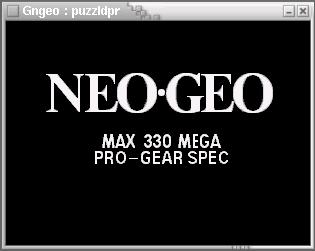 neogeo emulator
Gngeo is a neogeo emulator for linux (and some other unix) released under the GPL. main Features are:
- Good emulation speed (60fps nearly all the time on a PII300).
- Raster interrupt emulation
- Nebula Transparency pack support
- opengl and yuv blitter
- Many different effect (scanline, scale2x etc)
- Preliminary save state support.
License: free
Requirements: libSDL, zlib and nasm for i386 optimisation
| Sound: | Play in X: | Play in Console: | Multiplayer: | Network Play: | 3D Acceleration: | Source Available: |
|---|---|---|---|---|---|---|
| yes | yes | yes | yes | no | no | yes |
Submitted by anonymous on 2003-05-09.
* skovbaer_dk *
* skovbaer_dk *
samurai showdown
king of fighters
think best 2D scrolling shooters
think funny gameplay
not eye candy 3D
you go back to trolling school, you dont cash, you look silly.
so that leaves you to either ignore them and let the trolls exhaust themselves or actually for once, be nice to them and they will be terribly confused. The later works rather well :)
Garou: Mark of the Wolves gets my vote for best NeoGeo fighter.
May I suggest trying the « Download gngeo » link just right in front of your eyes ? I could be wrong, but I reckon there's a slight probability the emulator could be hidden there...
PS : stop yelling !
--{@ Ryo99.
K6-3 is superior to k6-2 and was released about a year after market acceptance of k6-2 to accomodate the laptop market. K6-3 is simply a lower power and higher performing k6-2 than can be used in either compatible laptops or motherboards that support its lower voltage settings. K6-3 is 1999 technology!!! It's not old! It performs verry well despite is reasonable power consumption! I have a k6-3 333MHz (AFK stepping) in a little clamshell CPU box and I'm waiting to throw it into a Netpliance I-opener or somthing realy small footprint! They perform well and I think it is a disgrace to the computer industry as a whole for companies that think the only way to improve performance is in designing CPUs that suck twice as much power as their predecessor!
Yes, you hit the nerve...I'm trying to control myself.. *#$WACK! !@#THUD...
Yeah suckit! Frist Post!
Imagine...if netcraft confirmed *BSD is dying, then we could all poor hot grits down our pants while watching natalie portman conquer all our base!
--{@ Ryo99.
That's not quite how I remember it. The K6-III is a K6-2 with 256K on-chip cache. The K6-2's performance didn't scale well after about 350Mhz because of the lack of high-speed cache (aside from a little L1 cache, it was stuck using cache on the motherboard, generally 512K of 100Mhz cache). Adding on-chip cache seemed like a good answer. The K6-III was released in speeds from 400-550 Mhz, with a few slower ones showing up (unofficially?) later on. It was advertised as a PII killer, was priced comparably at first ($500 for a K6-III 450 when they first came out!), and the main core actually did perform better than the PII (the FPU was another story). The K6-III was actually considered to be pretty hot-running for the time, especially the first release of the chips, which required 2.4V core (compared to 2.2V for the K6-2 and later versions of the K6-III).
The K6-2+ and K6-III+ are the laptop chips. They are lower-voltage (1.8V?) and lower power-consumption. They have 128K and 256K of on-chip cache, respectively. I believe that they also have the 3dNOW-2 (not just the original 3dNOW introduced in the K6-2) and PowerNow! technologies.
This is all from memory, but I'm pretty sure that it's accurate. Yeah, they're all nice chips. They were the budget user's choice for years. I myself used K6-2s at 333Mhz (non-CTX core), 350Mhz and 400Mhz at various times. Too bad non-Intel motherboards of the time were so mediocre.
What am I doing wrong?