







Go Siege
Version: 0.3
Category: Board
(not yet rated)

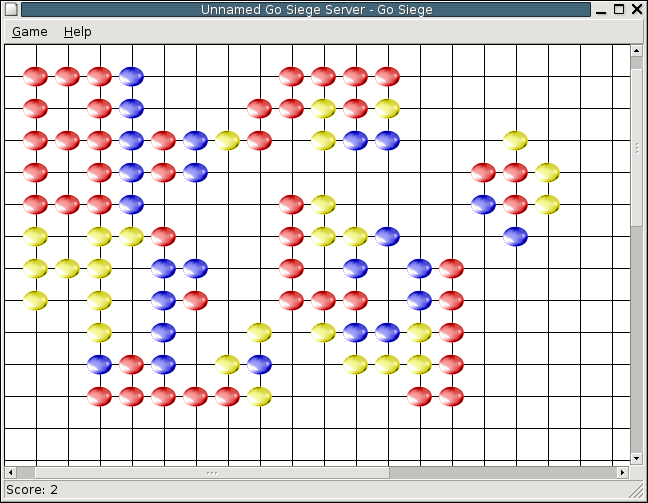 Massively Multiplayer Online Go
Go Siege is a transformation of the ancient Chinese game of Go -- a board game in which players compete by surrounding territory and capturing enemy stones -- into a massively multiplayer online game in which hundreds of players can compete simultaneously. Go Siege is open-source, being licensed under the GNU General Public License.
License: free
Requirements: Python 2.2, Twisted 1.1, PyGTK 2
| Sound: | Play in X: | Play in Console: | Multiplayer: | Network Play: | 3D Acceleration: | Source Available: |
|---|---|---|---|---|---|---|
| no | yes | no | yes | yes | no | yes |
Submitted by anonymous on 2004-03-15.
I'm also wondering how 'hundreds' can play simultaneously, if the only way to tell people apart is color?
Having said that, I'm looking forward to this :)
The answer is that you don't have to tell each players' stones apart. You only need to be able to distinguish adjacent units (contiguous regions of stones) apart.
At the moment, the board renderer uses a simple algorithm that colours the units of each player the same colour. Since I have only defined eight colours, it can only show eight players' units on the screen at once.
However, it has been proved that any geographical map can be coloured with only four colours. (See http://en.wikipedia.org/wiki/Four-color_theorem) The current algorithm will be replaced with a new one that takes advantage of this theorem to render the board using only a few colours.
-- Timothy Stranex
Anyway.. The idea behind this game is very nice. I am looking forward to playing it some day. Did you perform test games in real life to see if the rules are working?
The four color conjecture pertains to the domain of contiguous shapes which occupy the entirety of a 2-dimensional space. (Real maps could defeat the conjecture since real countries can be noncontiguous, cf. Alaska, Cabinda, the former unified Pakistan). Since a go player's stones are not generally all contiguous, this branch of math toplogy has limited applicability. It is certainly sufficient to distinguish all stone groups, but players will need more information to play well.
Indeed, the approach of individually colored groups could make it impossible to tell which stones can be captured, for a multiple groups can share a false eye for shared life. Two groups with an eye each can link via a false eye for life. One group with life can link to another group via a false eye to transfer effective life to the alternate group. In your game, which is somewhat different, a false eye itself is life, so will occur even more frequently.
That said, I don't think you want 700 players on one go board really. (Maybe I misunderstand?) so visually unique stones will probably work, even if some kind of sigil or bitmap is required.
In the 0.3 release, when you move the mouse pointer over a stone, all the stones owned by that player are highlighted. As far as I can see, this gives the player the same information as if each player's stones had the same colour albeit without the same efficiency. The 'Colours' section of the Go Siege manual has a screenshot of this.
-- Timothy Stranex
I don't have any plans to make surrounded territory influence the player's score at the moment; however, I will consider it.
I would like to make a port for OS X. It shouldn't be too difficult to port because Python and PyGTK are available in Fink. Unfortunately, I don't have access to a Mac so unless some other developer decides to help, it won't happen soon.
Hmm, in the current software, it seems that you have capture rules which are somewhat different from go. That is, it seems the game does not allow you to play stones which would capture, if they they themselves are surrounded.
Consider the classic case:
Go rules allow # to play at 1, which successfully captures the left O stone. this means that the spare network of 4 unconnected stones is not secure. Your server does not allow this capture, which means that this spare shape:
Has life.Even more severe, consider the corner!
Two stones, and we have life. Given how easy it is to create uncapturable shapes in this game, I cannot forsee very interesting capture fights arising. Capturing will have to occur right away or it will never happen. Certainly, if a twisty network of many players occurs none of whom yet have life, it could get interesting, but I doubt this will occur often, given that you can get life in the open in four moves.Essentially this is not all that much like Go. Obviously, the value of big eyes falls in multi-player, and realtime, but the most basic rules of life and death should probably remain, as they afford a better/more interesting game.
Hi,
The life patterns you described above are not intentional. The previous versions did not have these defects. In fact, you can fix the 0.3 release by changing line 168 of rules.py from "if (libgain > 1): return True" to "if (libgain >= 1): return True".
Thanks a lot for pointing out the bug.
-- Timothy Stranex