







Gtkboard
Version: 0.11pre0
Category: Board
(not yet rated)

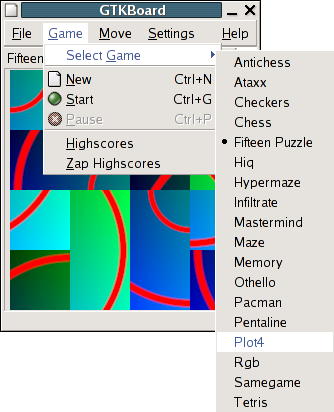 Collection of board games
Gtkboard is a board games system. It implements all the common aspects of board games, such as the user interface, move parsing code, AI and file format. Games are fitted in as plugins. Currently more than 30 games have been fully or partially implemented. Some are single player and some are two player games. The user can play with the computer or with another person. It supports infinite undo and redo of moves.
License: free
Requirements: gtk+ version 1.2 or higher is required. However, there are a few features that will work only if gtk+ version 2.0 or higher is available.
| Sound: | Play in X: | Play in Console: | Multiplayer: | Network Play: | 3D Acceleration: | Source Available: |
|---|---|---|---|---|---|---|
| yes | yes | no | yes | no | no | yes |
Submitted by nilfilter on 2003-07-23.
It's at an early stage so I'm not going to rate it now. The graphics currently need polishing. The game also needs documentation for the different game types. It would be nice if the engine supported hexagonal tiles, and also allowed one to write game ruls in a higher level language, such as Python or Scheme. With a bit of work, this will be a great game engine.
I'm the author of gtkboard. Thanks for your comments.
"The graphics currently need polishing." Too true. So little time, and I'm not very good at graphics design :-( It would be great if someone were to contribute some pixmaps and icons and suggestions for improving the UI etc.
"The game also needs documentation for the different game types." Could you please explain what you mean by this? There is some documentation in http://gtkboard.sourceforge.net/doc and each game has About/Rules/Strategy sections in help. As for "different game types", there's just single player and two player games.
"It would be nice if the engine supported hexagonal tiles" Yup. Planned, but not for the next few months.
"allowed one to write game ruls in a higher level language, such as Python or Scheme". That's a great idea. I'd thought of that too, except I don't know much about these languages. Any tips on how I can embed a Python/scheme interpreter in the program?
BTW, I've released a couple of new versions. There are now 20 games :)
arvindn
The exact details of how to embed a script interpreter into a C program differs for each scripting language. However, all embeddable interpreters are implemented as dynamic libraries that export an API for creating an intepreter, adding application-specific types and functions that allow scripts to call back into your application, and executing code stored in strings or files. Most scripting languages have very good C APIs for embedding. You can make it even easier to support new languages by using the SWIG tool and including the interface file in the source distribution.
In GtkBoard, you would need to instantiate an interpreter, export the plugin API to the interpreter, execute some function to initialise the game and then run functions to handle moves. Your plugin API is defined by you, but the scripting APIs are defined by each language, so you would need a plugin for each language that translates the plugin API to script calls and vice versa. The plugin would be linked against the scripting library and instantiate the interpreter in an initialisation function.
You would only need to write this once for each language. When the user wants to play a game implemented in Python, for example, GtkBoard would load the Python plugin and tell it which script file to execute. Similarly for Scheme, Ruby, Lua, and other supported scripting languages.
Sorry for sounding bitchy but aren't there like five or six of these already? None of them ever seem to implement the tricky stuff with unusual coordinates or allowing the developer to define their own.
I guess this is one of the cases where the free software world doesn't ever solve the hard but not all that interesting problem.
Well that's because 95% of board games use rectangular coordinates.
aren't there like five or six of these already?
Really? Care to name some of them? The only one that I'm aware of is gridlock, and its mainly for MacOS X.
I guess this is one of the cases where the free software world doesn't ever solve the hard but not all that interesting problem.
Huh? No idea what you mean by that. Non-rectangular boards are neither hard nor uninteresting. Its just that they aren't useful. I mean, if you have a highly unusual board type what's the point of implementing it in what's meant to be a generic engine?
Besides, gtkboard already (partially) allows you to draw the board yourself, which means you can draw arbitrary boards. If you have some ideas about what types of alternative grids would be useful, and how to implement them, why don't you join the mailing list and share your thoughts? It would be a much better way to spend your time, wouldn't it?
Arvind (lead dev)