







HoloRacer
Version: 13
Category: Arcade
Average of 2 Ratings: 

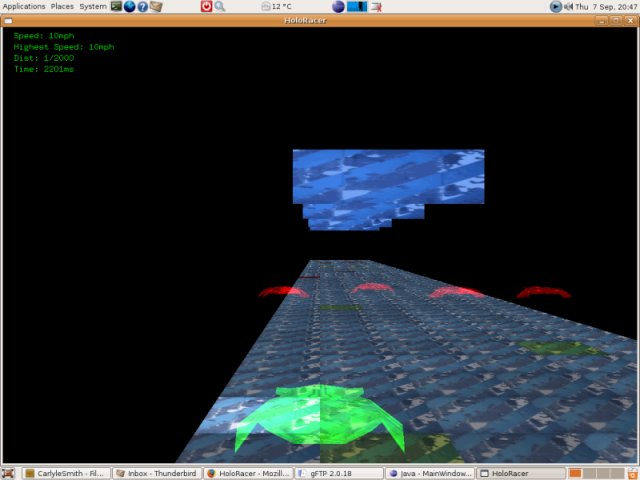 Intended to be the fastest racing game possible
Holoracer is intended to be the fastest racing game possible. Based on the game Trailblazer, it is designed to be fast and furious with psychadelic graphics with incredible speed. Also includes network play.
License: free
Requirements: java
| Sound: | Play in X: | Play in Console: | Multiplayer: | Network Play: | 3D Acceleration: | Source Available: |
|---|---|---|---|---|---|---|
| no | yes | no | no | no | yes | yes |
Submitted by Joshua on 2006-09-10.
Do you plan to use JOGL? It would be quicker.
import net.java.games.jogl.*; import net.java.games.jogl.util.*;
You're using JOGL. Why do you say that you use LWJGL?
Exception in thread "main" java.lang.UnsatisfiedLinkError: net.java.games.jogl.impl.JAWTFactory.JAWT_GetAWT0(Ljava/nio/Buffer;)Z at net.java.games.jogl.impl.JAWTFactory.JAWT_GetAWT0(Native Method) at net.java.games.jogl.impl.JAWTFactory.JAWT_GetAWT(JAWTFactory.java:37) at net.java.games.jogl.impl.NativeLibLoader$1.run(NativeLibLoader.java:78) at java.security.AccessController.doPrivileged(Native Method) at net.java.games.jogl.impl.NativeLibLoader.load(NativeLibLoader.java:58) at net.java.games.jogl.impl.x11.X11GLContextFactory.(X11GLContextFactory.java:50) at java.lang.Class.forName0(Native Method) at java.lang.Class.forName(Class.java:169) at net.java.games.jogl.impl.GLContextFactory.getFactory(GLContextFactory.java:69) at net.java.games.jogl.GLDrawableFactory.createGLCanvas(GLDrawableFactory.java:150) at net.java.games.jogl.GLDrawableFactory.createGLCanvas(GLDrawableFactory.java:118) at net.java.games.jogl.GLDrawableFactory.createGLCanvas(GLDrawableFactory.java:85) at ssmith.opengl.Canvas3D.getGLCanvas(Canvas3D.java:287) at ssmith.opengl.Canvas3D.(Canvas3D.java:57) at holoracer.MainWindow.(MainWindow.java:64) at holoracer.Main.(Main.java:35) at holoracer.Main.main(Main.java:54)
I think that's because I don't use the same version of JOGL. Is there another reason?
To the author of the previous post: Now that you mention Tribal Trouble I would like to post an email from one of the developers. I asked them whether TT was completely written in Java because I discuss a lot with my collegues about crossplattform development. I also always try to point out that java isn't slow anymore and try to prove it with mentioning TT.
Here is the answer:
Hi Silvio,
The short answer is yes, everything is written in java. The long answer is that _almost_ everything is written in java. In particular we've had to use LWJGL (http://lwjgl.org) to access certain native APIs that java doesn't have builtin. These include OpenGL for 3d rendering and OpenAL for sound and music. LWJGL is simply a glue layer and only contains the absolute minimal amount of native C code to access the APIs through JNI. It doesn't contain any logic, so it's safe to say that everything is java. For example, this is the java method for glDrawElements in GL11.java:
public static void glDrawElements(int mode, IntBuffer indices) { long function_pointer = GLContext.getCapabilities().GL11_glDrawElements_pointer; BufferChecks.checkFunctionAddress(function_pointer); GLChecks.ensureElementVBOdisabled(); BufferChecks.checkDirect(indices); nglDrawElements(mode, (indices.remaining()), GL11.GL_UNSIGNED_INT, indices, indices.position() << 2, function_pointer); }
and this is the native C part of it:
JNIEXPORT void JNICALL Java_org_lwjgl_opengl_GL11_nglDrawElements(JNIEnv *env, jclass clazz, jint mode, jint count, jint type, jobject indices, jint indices_position, jlong function_pointer) { const GLvoid *indices_address = ((const GLvoid *)(((char *) (*env)->GetDirectBufferAddress(env, indices)) + indices_position)); glDrawElementsPROC glDrawElements = (glDrawElementsPROC) ((intptr_t)function_pointer); glDrawElements(mode, count, type, indices_address); }
That's the general pattern of all OpenGL and OpenAL functions.
Regards,
Elias Naur
Oddlabs ApS
any one dismissing a game because its written in java doesn't really know what they are talking about and their arguments are usually out of date by about 10 years.
The usual problem with java as a game development language isn't that the JVM executes the code slowly. The problems are that the language is fat and verbose, which slows down development compared to other virtualized languages, the libraries are often poorly implemented, and that the behavior of the JVM, combined with poor libraries and a low quality culture of coding practices leads to incredibly bloated memory use.
The only unavoidable problem here is the language verbosity, and since most game developers are selecting among C, C++, and Java (when considering Java), Java doesn't lose by much. It's perfectly possible to be very circumspect about your library choices, and it's possible to not blindly use foolish development practices (eg. pattern madness). Game development where performance matters (like 3d work) should tend to enforce this kind of rigor.
Unfortunately there are plenty of Java games that underline that it is all too common to fail to make such good choices when there is no enforcing rigor. Sillysoft's Risk clone for java (the name escapes me) cannot manage to simply play some bitmap animations and a few mixed sounds on a p3-900mhz class machine. This is stuff that was accomplished on 8mhz computers.