







Hyperspace Delivery Boy
Version: 0.9j
Category: Action
Average of 2 Ratings: 

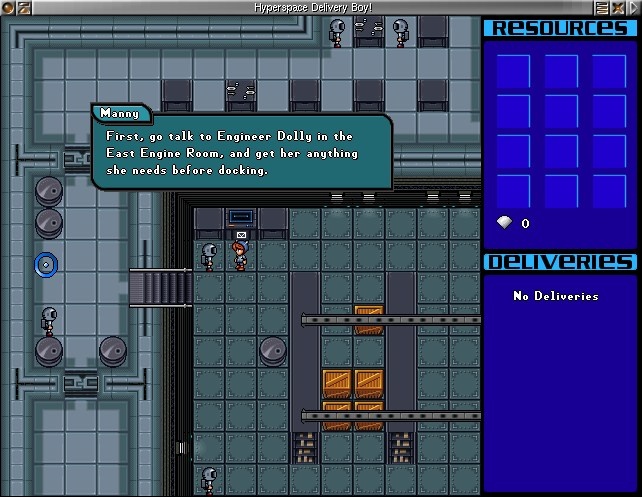 Deliver packages in the future.
A funny 2d action-puzzle game designed by Tom Hall and written by John Romero. Released in 2002, it is reminiscent of SNES-era action games.
You are Guy Carrington, fresh on the job as a courier for the Hyperspace Delivery Service. Your job: get mail and packages to those that need them, no matter where in space they are! You may face insane robots, dangerous environments, or even the dreaded Sleeping Behemoths on your quest to deliver the universe`s most important parcels! Explore bizarre worlds and defend yourself against alien creatures as you solve the devious puzzles of... Hyperspace Delivery Boy!
- Journey through thirty amazing levels!
- Choose puzzle or action-puzzle modes!
- Revel in three amazing, completely different environments!
- Find hidden bonus items!
- Escape from the Crazy Panic Zones!
License: commercial
Cost: $20.00
Requirements:
- Linux Kernel 2.2.x or later
- GNU C Libraries (glibc) 2.1.x
- XFree86 Release 3.3.x or later
- 200 MHz x86 Processor
- Graphics card with 4MB of RAM
- 32 MB RAM
- OSS compatible sound card
- 70 MB free hard disk space
- 4x CD-ROM drive
| Sound: | Play in X: | Play in Console: | Multiplayer: | Network Play: | 3D Acceleration: | Source Available: |
|---|---|---|---|---|---|---|
| yes | yes | no | no | no | no | no |
Submitted by mark7 on 2005-05-28.
But I played the demo last year its r5ealy quite fun :P
Edd
john romero's gonna make you his bitch!
There , I feel better now.
HDB ships with a static binary (hdb) and a dynamic binary (hdb.dynamic).
The hdb binary is linked against an aging version of SDL and has some odd quirks (the cursor has a tendency to zip off in random diagonal directions, ALSA sound isn't supported, and so forth).
When running the hdb.dynamic binary, one has the benefits of the modern, bugfixed SDL present on your system, but at least in my case, all transparent areas of sprites have been replaced with magenta pixels. If everything looks like a set of big purple boxes containing sprites when you run hdb.dynamic, you have the same problem.
For some reason, while the keyed transparent color remains the same in the hdb.dynamic binary, it seems that the color of the sprites is actually less intense in the transparent areas than in the hdb binary, and thus no longer matches the transparent color. I'm not sure why this is, but we can fix it. I've whipped up a quick library interposer, a library that sits between SDL and HDB and makes things work properly.
You'll need a couple things: first, the SDL-devel package to compile an SDL-using library, and second, the following files: A Makefile that looks like the following:
CFLAGS+=`sdl-config --cflags`

all: sdl_compat.so

sdl_compat.so: sdl_compat.o
        $(CC) `sdl-config --libs` -o $@ -shared -fPIC $<
and a sdl_compat.c file that looks like the following:
#define _GNU_SOURCE

#include <SDL.h>
#include <dlfcn.h>

int SDL_SetColorKey(SDL_Surface *surface, Uint32 flag, Uint32 key)
{
        static int (*func)(SDL_Surface *, Uint32, Uint32);

        if (!func)
                func = dlsym(RTLD_NEXT, "SDL_SetColorKey");
        if (key == 0xff00ff)
                key = 0xf800f8;
        return func(surface, flag, key);
}
Dump the Makefile and the sdl_compat.c file in the same directory and type
to build sdl_compat.so. Once it is successfully compiled, you'll want to set LD_PRELOAD to the full path of sdl_compat.so, cd into the directory containing the hdb.dynamic binary, and then run hdb.dynamic. On my system, this looks like the following:
And ta da! No more purple sprites!
I've only tested this interposer through maybe 10% of the game, but it works swimmingly thus far.
I'm going to end this post with a short version of the same tidbit that I tacked onto my "making Jagged Alliance 2 work on modern systems" post. It's a real pain to troubleshoot and fix problems with closed-source binaries on Linux. It'd be awfully nice if game vendors would consider GPLing the source to their old games. Source to an old game engine is rarely valuable, especially if the data files are not included in the public release. The developer may not be selling any copies (the game may even be out of production). Nobody is going to take the source and run out and make an alternate game with new datafiles that then outcompetes the developer's current games. Few game developers have the time or resources to maintain old codebases, and this makes it much easier for the community to maintain and ensure the playability of old games -- and may provide the developer with more direct sales of CDs with the data files on them, squeezing a bit more life out of a golden oldie. It's an inexpensive (free) way to provide some degree of essentially unlimited support to customers. A number of games have been seeing this treatment recently, and it is much appreciated by the community.
Anyway, enough of the heavy social arguments -- get out there and deliver some packages!
-- Mark Schreiber ([email protected])