







Transcend
Version: 0.3
Category: Action
Average of 8 Ratings: 

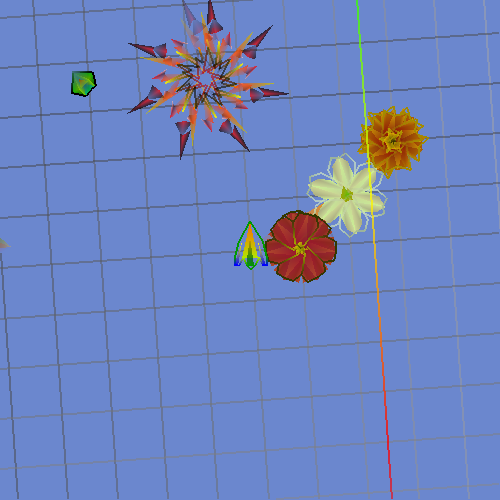 A retro-style, abstract, musical 2D shooter
And now for something different ... a Shoot-em up meets music meets symmetry.
You control a glyph in a grid world, with elements which you can pick up and arrange. By arranging the elements, you become more powerful and also build an abstract musical experience based on the design you put together. You fight against the anti-glyphs who try and destroy your design and the Major anti-glyph who you must defeat to progress to the next level.
License: free
Requirements:
| Sound: | Play in X: | Play in Console: | Multiplayer: | Network Play: | 3D Acceleration: | Source Available: |
|---|---|---|---|---|---|---|
| yes | yes | no | no | no | yes | yes |
Submitted by tjwhaynes on 2004-09-22.
../../minorGems/graphics/openGL/ScreenGL.o ../../minorGems/io/linux/TypeIOLinux.o
../../minorGems/util/stringUtils.o ../../minorGems/util/StringBufferOutputStream.o
../../minorGems/io/file/linux/PathLinux.o ../../minorGems/system/unix/TimeUnix.o
../../minorGems/system/linux/ThreadLinux.o ../../minorGems/system/linux/MutexLockLinux.o -L/usr/X11R6/lib -lGL -lglut -lGLU -lX11 -lXi -lXext -lXmu
SoundPlayer.o(.text+0x686): In function `SoundPlayer::SoundPlayer[not-in-charge](int, int, void*, double)':
/home/james/games/Transcend_0.1.1-IGF-1_UnixSource/game1/game/SoundPlayer.cpp:146: undefined reference to `Pa_Initialize'
SoundPlayer.o(.text+0x6cd):/home/james/games/Transcend_0.1.1-IGF-1_UnixSource/game1/game/SoundPlayer.cpp:150: undefined reference to `Pa_GetDefaultOutputDeviceID'
And so on...
PLATFORM_LINK_FLAGS = -L/usr/X11R6/lib -lGL -lglut -lGLU -lX11 -lXi -lXext -lXmu ${ROOT_PATH}/game1/portaudio/lib/libportaudio.a -lpthreadThen call the runToBuild script again.The game itself looks and sounds kinda interesting, but I haven't fully understood it, yet.
--Jason (the Transcend dev)
I feel like I miss the point of the game - so no rating from me.
and the objectives of the game aren't clear. Plus it is really too easy to pass a level.
I'm not sure if this game has really potential.
Sound has two main subsets, music and noise. The distinguishing feature between them, is the sounds that make up music were put there for a reason, the sounds that make up noise were not.
Now music has many, many rules. However music is an artform, and so most of those can be broken, there is only one rule that is unbreakable, each note has to be part of a larger context. Each note enriches a bar which enriches a phrase which enriches a song or movement which enriches and album or piece. The note must be placed there with the whole of its surroundings in mind. A note is worthless on its own and does not make music, in the same way a single compression wavefront does not make a sound, a note must be chosen to flow with the note before and after it. What we have in transend seems to be merely a pick-and-mix selection of loops of random notes performed by a rainbow coloured line. Where is the art in that? Where's the beauty? Where's the meaning? Even the most innane pop-song was written by a human with the ability to actually express something beautiful, meaningful or even catchy. This is just made by some computer program by random numbers. If one was to call this music it would degrade an entire artform.
I agree that what Transcend produces isn't exactly music, but instead random sounds, like a wind-chime makes. There are certain principles of design in music (as you mentioned) that don't come into play in this game.
(It seems to be taking a page from Electroplankton's book (requires Flash; site is mostly Japanese, but easy to navigate; the leftmost bubble has a short video/audio demo). But Transcend doesn't have the variety of gameplay or the cute characters that EP does.)
There are also principles of graphic design and game design that are ignored (I won't call it art, because this game doesn't seem to be an attempt to communicate meaning):
- Composition. All the "collage elements" have to be placed near the center, or connected to the center via other elements. Even a beginning 2D Design book will tell you that putting your focus on the center of the page generally makes the work less interesting. Beyond the requirement of all elements needing some connection to the center, the gameplay encourages "clumping" them all together near the center, which makes them easier to defend. The player is required to stay near, or frequently return to the center in order to defend it and/or reposition collage elements.
- Variety/Contrast. All the collage elements within each stage are very similar in size, shape, color, and sound. All the elements "bloom" with the same rhythm, at the same time. All the stages are set on a square grid; why not try triangles or hexagons as well? All the stages have the same gameplay: collect elements, fend off small enemies, and kill the boss enemy. All the enemies and bosses behave the same across stages. The player's ship and weapon are essentially the same in each stage.
- Challenge. There is no way to lose this game. There is only one essential challenge present: achieve some goal (the retrieval of another element, or the destruction of the boss) before the smaller enemies dismantle your clump of elements. The only risk associated with this challenge is that you will have to spend about 10 seconds repositioning your elements if you fail, before attempting the challenge again.
- Feedback. Unless the player is near the center to see it happening, the only way he will find out that enemies are invading his collage is when his weapon suddenly becomes less powerful. This is an unsatisfactory level of player feedback—if a player is supposed to prevent something from happening, he needs to be aware that it is about to happen. Visual and/or aural cues would go a long way.
However, despite the above, this game isn't bad. Mediocre, perhaps, with the potential to be much better. It does some things well: visual theme, shape, and (to a modest extent) synesthesia. I hope the author develops this game further.
Although it’s quite theraputic as it stands, I think it needs a bit more purpose, stuff like time limits for completing a level, maybe make the playfield bigger as you go (so your ship has to go further to fetch glyphs), and the nasties tougher (with a few glyphs near the center, one shot generally deep-sixes a nasty), extra guru points for forming specific patterns and so on.
It also needs command-line options to start fullscreen and/or with decent resolution, and I think a simple “splash” overlay at startup would explain all you needed to know about the controls.
If there was a 2.5 star rating, I'd have given it that, but I think it's polished and engaging enough to have earned better than 2.
I am running Debian unstable on a P4 with a 64 MB Nvidia Geforce 2 MX 200, 1024x768x24.
Debian (Unstable), Geforce 2 MX (32mb), AMD Athlon k7.
Ubuntu Hoary, Diamond Viper 550C, Nvidia Riva TNT with Nvidia-drivers. freeglut3 2.2.0-8 other 3d-games like UT run perfectly.
Right now, this game can't carry the artistic pretentions it seems to aspire to. It's emotional effect is to calm/bore the user. To some, that is the very definition of art but not me.
It's a cute toy. Hopefully it will evolve to be something much more interesting.